
Your knee has a geometry that's unique to you. A good replacement should respect it.
Total knee replacement has a reputation for being a painful, slow recovery with unpredictable results. Dr. Rubinger's approach is built around challenging that reputation — using techniques that preserve more of your natural knee anatomy and work with your body rather than overriding it.
-
A surgical procedure to remove and replace damaged cartilage and bone in the knee joint with artificial metal and plastic components
-
Luc uses a muscle sparing approach called the subvastus approach, with inverse kinematic alignment to respect your native knee anatomy

Kinematic Alignment — The Philosophy
What most knee replacements do
Conventional total knee replacement uses what's called mechanical alignment — placing the implant in a standardized, neutral position based on the long axis of the leg. It works reasonably well for many patients, but it doesn't account for the fact that everyone's knee is slightly different. For some people, a mechanically aligned replacement ends up in a position that doesn't quite match how their knee naturally moved, which can mean stiffness, a different gait, or a knee that just never quite feels like theirs.
What kinematic alignment does differently
Inverse Kinematic alignment (iKA) takes a different starting point: your knee's own natural geometry. Rather than aiming for a "neutral" position defined by a formula, Dr. Rubinger maps the alignment to the way your specific knee was designed to move. The goal is a replacement that re-creates your natural motion patterns as closely as possible — which tends to mean better range of motion, a more natural walking pattern, and a knee that simply feels more like a knee.
Why it works across every platform
Dr. Rubinger has developed his own iKA technique that he can execute precisely whether he's using the ROSA robotic system, the MAKO robotic system, or conventional instrumentation. That matters because it means every patient benefits from kinematic alignment regardless of which setting they're operated in — the technique is genuinely reproducible, not dependent on any single platform.
The Sub-Vastus Approach
A different way in
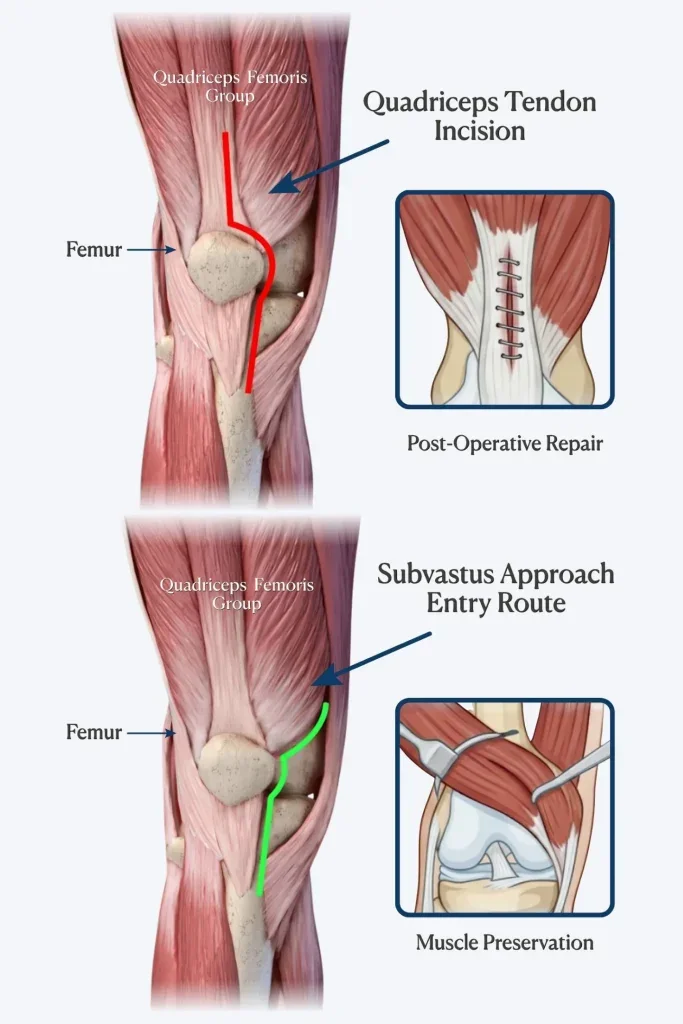
Most knee replacements involve cutting through the quadriceps tendon to access the joint. Dr. Rubinger uses a sub-vastus approach, which means he works under the quadriceps muscle rather than through it — leaving the muscle's attachment and nerve supply intact.
What this means for recovery
Earlier activation of the quad muscle after surgery. Less pain in the first days and weeks postoperatively. More normal quadriceps function and strength during recovery. Better preservation of the natural Q angle — the alignment between hip, knee, and ankle that affects how you walk. Most patients are surprised by how soon they're moving. That's partly the goal of this approach.
Robotic-Assisted Surgery
Dr. Rubinger performs robotic-assisted knee replacement on two platforms: the ROSA system (Zimmer Biomet) and the MAKO system (Stryker). Robotic assistance enhances accuracy in implant positioning and supports the precision goals of kinematic alignment.
Partial Knee Replacements When less is more.
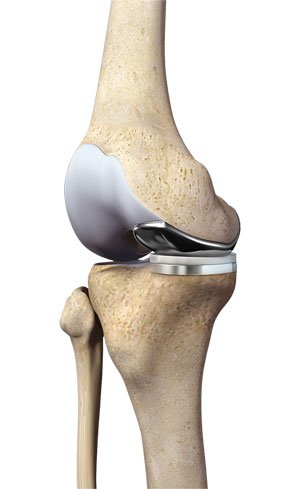
Not every worn-out knee needs a full replacement. When arthritis is confined to just one compartment — usually the inner side — a partial knee replacement replaces only what's damaged and leaves the rest alone.
That means more of your natural bone, ligaments, and cartilage stay intact. Patients typically notice a more natural knee feel, better range of motion, and a faster recovery. Most go home the same day.
The catch: patient selection matters enormously. A partial works beautifully in the right candidate and poorly in the wrong one. That's a conversation for the clinic.
Precision-guided with the MAKO Robot
At Lakeridge Health Ajax, partial knee replacements are performed using the MAKO robotic system — the gold standard for the procedure. A CT-based 3D model of your knee guides the surgical plan before you enter the OR, and MAKO keeps every bone cut to submillimetre accuracy during surgery. The implant fits your anatomy, not an average.
What to Expect
Before surgery
Dr. Rubinger will review your imaging, discuss your history and goals, and explain which approach makes the most sense for you. He'll be direct about what surgery can and can't achieve, and realistic about what recovery looks like.
The procedure
Total knee replacement is typically a 1.5–2 hour procedure performed under spinal or general anaesthetic. Same-day discharge is offered at both the Schroeder Ambulatory Centre and Lakeridge Ajax for appropriate candidates. Patients requiring an overnight stay are accommodated at Lakeridge.
Recovery
Most patients are walking with assistance on the day of surgery. Physiotherapy begins immediately. Full recovery, returning to most activities, typically takes 6–12 weeks, though individual variation is significant. Dr. Rubinger will set realistic expectations and check in with you throughout.